Pray Give Go
and the reckoning I carry

Field Notes from the Afterlife is a weekly-ish letter on the stories we tell ourselves, and the strange clarity that comes once the world you trusted falls apart. If something here steadies or stays with you, feel free to reshare it. Thank you for reading, liking, commenting, and helping this space stay alive. You can learn more about me and what I am up to at: www.sarahstiltner.com.
This is Part 4 in a Series. Read Part 1 Read Part 2 Read Part3

The recent happenings in Germany and other countries have caused an awakening in the people of Europe. Things are not as they once were. It is an unsettling time in Europe. This has caused a new openness among the Europeans. May we give the Lord His way in the midst of this “sudden striking” that we are witnessing in these days in Europe. (source)
In 2016, Germany faced the largest influx of refugees in decades, the majority fleeing the war in Syria. Cities and towns became points of passage for families carrying what they could, navigating unfamiliar streets, crowded shelters, and bureaucratic hurdles that could decide the fate of a life overnight.
The brothers in the Lord’s Recovery put out a call and all were encouraged to participate. We all could PRAY, GIVE, or GO. We watched heartbreaking videos and I truly believed that after years of conferences and trainings and morning revivals, we were finally going to respond to real human need. My husband and I signed up to go as part of a larger team; we were assigned to Stuttgart.
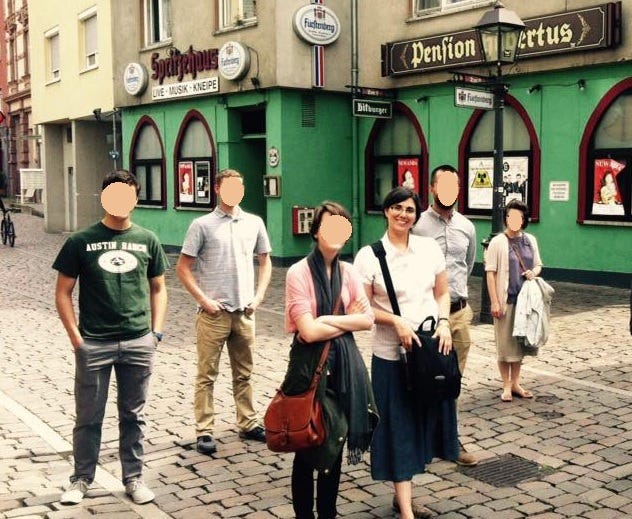
For those of us arriving in Stuttgart that summer, the headlines and images of urgent need carried a moral weight we were eager to bear.
The bubble burst before we had even unpacked.
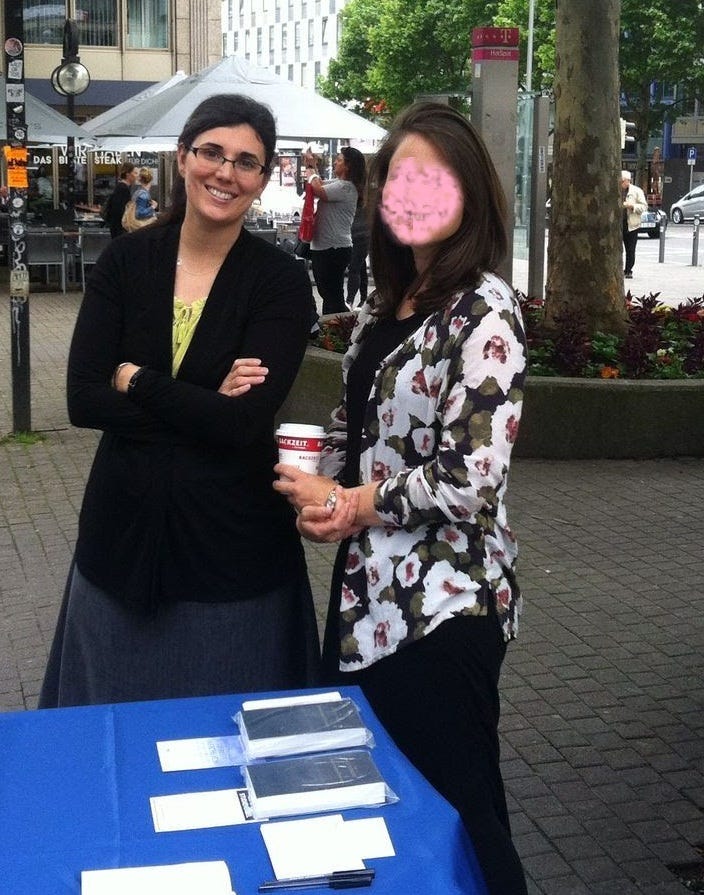
We were told that we would not be going to camps. At all. Instead we were handed bibles and directed toward the streets. Not the refugee camps. The streets of Stuttgart, where German commuters were hurrying to work or heading home. Corners, commuters, polite refusals, indifferent acceptance, the weight of doctrine pressed into hands like a measure of absurdity.
I carried each one and felt the first tremors of shame, realizing that what we had believed to be human care was already distorted into recruitment. We had come to help people fleeing war. We were handing out footnoted bibles to people trying to catch a train.
One day, the fracture became something sharper. I was standing in hostel lobby when two “brothers” rushed in, urgently demanding to know who there spoke German. Their urgency was so intense, I honestly though there was some emergency. My German was barely conversational, but I had been classified as a “German speaker” so I stepped forward. Before I could even blink, I was literally seized by the arm and hustled off to a car. Without any explanation, we all jumped in and rushed away. It was several minutes before I fully understood what was happening.
A woman had broken down on the side of the road. She needed help.
And they wanted me to go to her… on the side of a busy, narrow road, and offer her a bible and invite her to a gospel event. I could not believe what I was hearing. I argued, insisting it was inappropriate, desperately wishing I wasn’t there. We pulled up and one of the brothers said that we would not leave until I “seized the opportunity to speak for Christ.”
We sat in the car, watching her standing beside her disabled car, frustrated and alone, and I felt the full obscenity of what I knew was inevitable.
I did what they asked.
I approached her in broken German, held out the bible, spoke words she did not need, and walked away while her car remained broken and she still alone. She had not asked for salvation. She had not asked for anything. And still I could not offer her any real help, because that was not why we were there. I walked away ashamed—carrying the awareness that her need had been recast as opportunity, and that I had become complicit in the distortion.
A few days later, we were invited to sit at a table that would undo something in me permanently. We had met a Muslim family on the street and, of course, had offered them a bible. They politely took it and then invited us to join them in their small apartment for a Ramadan meal.
We were encouraged to go, the brothers were excited even. Their goal for us, of course, was to introduce the ministry and preach the gospel.
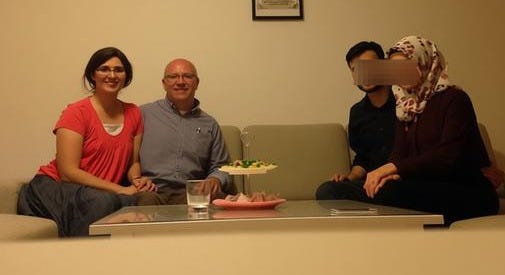
The night unfolded in a way I never could have imagined. They welcomed us with ease, arranging the table with care, asking about our families and listening with genuine interest. They spoke to us as if we were neighbors, not projects. There was no agenda. No attempt to persuade. No doctrine introduced, no literature offered, no invitation extended to anything beyond the meal itself. They never once mentioned their faith. They simply lived it—in the food they had prepared, in the attention they offered, in the dignity with which they treated two strangers who had come to their table carrying obligations they knew nothing about.
And they did all this knowing they would never see us again.
I looked across the table at my husband and knew we were both experiencing the same rupture. It was the first time in my adult life that someone outside our tradition had offered a form of goodness that demanded nothing in exchange, that carried no doctrine as its frame, that existed independently of recognition or conversion. A goodness we had been taught to fear. A goodness we had been told was inferior to our own. And yet here it was—unmistakable and entirely free.
We were expected to invite them to a gospel event the next day. Neither of us could do it. We could not turn their hospitality into strategy. We could not shape their kindness into a measure for our own purposes. In the silence that followed our quiet refusal, something inside me shifted in the story I had been living, years of belief and obedience falling apart during that Ramadan feast.
Even now, years later, the grief lingers. Grief for the harm I inflicted in the name of this so-called faith—for the corners I stood on handing out words instead of care, for the woman beside the broken car whose need I reduced to an opportunity for performance, for the people I welcomed into this system, people I loved, people whose lives were altered, constrained, or damaged by my compliance and participation.
What I could not name then, but understand now, is that what the Muslim family offered was not only human kindness.
They offered an indictment.
Not with argument, not with accusation, not with any attempt at correction. And they offered it humbly, in the measureless way they lived, in the care they gave freely, in the dignity they extended without asking us to change or become anything we were not.
The exact opposite of what we were doing.
Even to this day, the weight of that night has not lifted. Because I I now see so clearly, just how the system I served transformed need into opportunity and care into a transaction. And I did too.
And so I grieve. Not because I feel sorrow for myself, not because I hope for forgiveness, but because this is a lesson I can never move on from. There is no excuse.
Instead, it is a reckoning I carry, a persistent mirror hold up to the choices I made and the complicity I allowed.
Thanks for sharing this.
I also found myself in Germany in the summer of 2015. I had been experiencing a long-simmering discomfort with the Recovery’s exclusive focus on college campuses and our perpetual inward gaze. So when the opportunity arose, I was eager to put my German language skills to work helping “the least of these” in a way that seemed fresh. The trip had been promoted as an opportunity to work with refugees during a unique period in history.
Like you, I found myself disillusioned when it seemed like bible distribution and campus outreach were at least as important to the organizers as work with the refugees. No one had asked if I wanted to do that (I would have said no), and to me it felt like a bait-and-switch. I had 2 things going for me, a decent command of spoken German and the ability to drive a manual transmission, which meant that I spent something like half of my time actually meeting with refugees. There were others on the trip who spent most / all of their time manning “Kostenlos Studienbibel” tables.
As far as refugee work went, I’m glad that the brothers in charge of my group had a different take on “the mission” than you experienced. Maybe they had learned lessons from trips like yours. We were told to go and listen. Show interest and hear their stories. Make friends. If they were interested, we could put them in touch with local saints. We had been coached to never show up empty-handed, so we would knock at the door and hand them a bag of cookies or drinks that they would turn around and serve back to us. We had some amazing experiences of receiving hospitality from refugees and listening to their harrowing tales. I stayed in touch with one family for about a year after the trip. I also got to help a family take their child to the doctor and translate for them. That was extremely moving for me, and I’m glad for that experience. That part of the trip I treasure.
But I came away with deep misgivings about the other aspects of our trip. The main thing was the way the brothers coached us not to mention any sending organization. We were “just Christians who wanted to come hear stories and help however we could.” Don’t mention Aid My Freedom, LSM, Amana Trust, Local Churches or any of that. We were not part of an organized group. We were to stay under the radar because the German government did not want people showing up to proselytize (that’s exactly what we were doing). We were being asked to lie, because our trip had very much been organized by LSM-associated organizations. And we were very much there to proselytize.
Next, I found myself very bothered by how much we resembled the Jehovah’s Witnesses, who were also very active in the same places we were. We had been given a dress code, and it was very close to the JWs. When I asked one of the leading brothers why we had a dress code that made us look like JWs, he said, “Don’t be bothered by that. We have the truth, and they’re just an imitation of us.” That did not help me feel any better.
Finally, there was a moment in one of the plenary sessions on the weekend in the middle of our 2-week visit when one of the brothers stood up to exhort us. “What sets us apart from all the other Christian groups working here…” he said with a straight face “…is that we have the One Accord!” The irony of that statement hit me like a hammer. That particular “Dear One” was not part of the official leadership of the group, and so I chalked it up to his misunderstanding of our true purpose. But it left me unsettled, to say the least.
It would be another 6 years before I realized that such statements were “features” not “bugs” in the teaching of the Recovery. By then the dissonance had increased to the point that my wife and I would make our exit. But that trip stands as a an important milestone in my own journey.